Health Check
Updated: Oct 5
12K (Session 69)
Distance | 12,172m on the watch, 7:40 AM to 3:06 PM |
Time | 7:26:06, your longest swim ever |
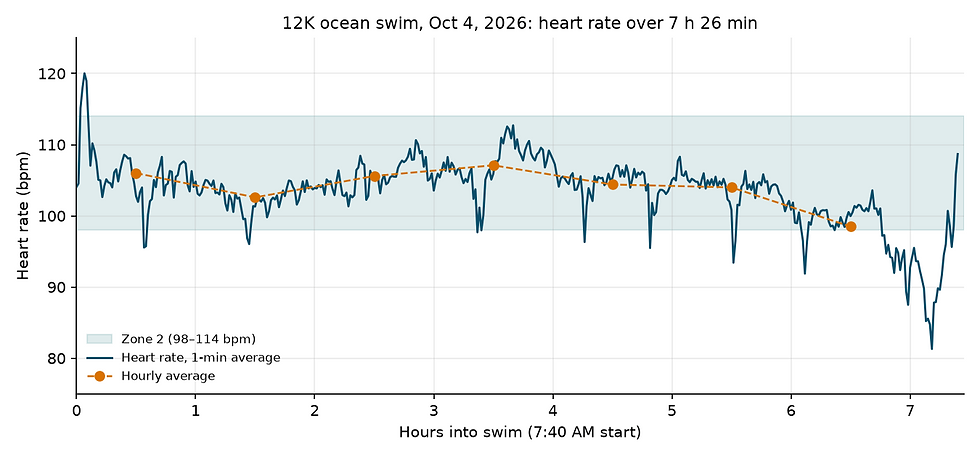
Heart rate | 103 average, 121 max. 89% Z2, 1% Z3, no Z4 |
Drift | 106 bpm in hour 1, 98.5 in hour 7, so it never crept up |
Pace | Hours 3 to 7 held 3:34–3:52 per 100m, and the last 1,210m was 3:42 |
The main finding is that on your longest swims, your heart rate held steady or eased down over time instead of creeping up:
Swim | Change from early to late in the swim |
Jul 3, 10.4 km | Rose by 7.3 bpm |
Sep 20, 8 km | Rose by 0.2 bpm |
Sep 27, relay | Fell by 3.3 bpm |
Oct 4, 12.2 km | Fell by 7.5 bpm (106 in hour 1, 98.5 in hour 7) |
On Oct 4 your average heart rate was 103 and your peak was 121, with 89% of the swim between 98 and 114 bpm. Speed relative to heart rate was about 3.5% better in the second half than the first. The short dips on the chart line up with the pauses on your GPS track, which were most likely feed stops.
Session 33 - 10K

Session 27 — FORM Analysis
The headline number: Zero cardiac drift from 1,000m through 6,500m. HR held flat at 96–99 bpm for 5,500m straight. That is not normal — it is exceptional aerobic efficiency and directly contradicts any concern that CAC 123 limits your ocean swimming capacity.
HR Profile
Distance | HR | What It Means |
500m | 107 | Entry surge, expected |
1,000–4,500m | 87–99 | Flat Z2 — no drift at all |
5,500m | 101 | Return leg, minor SR uptick |
6,500m | 105 | Building toward finish |
7,375m | 107 | Shore push |
Stroke Rate
33 spm avg — this is your true ocean long-stroke cadence, 12 spm lower than your pool sessions. Exactly what efficient open water swimming looks like. More glide, more DPS, less cardiac cost.
Zones
58.6% Z2, 38% Z1, 3.3% Z3 — you spent 96.6% of 3 hours 17 minutes in Z1/Z2. Max HR never exceeded 116. Never touched Z4.
What to Bring to Dr. Alam
Three numbers from this swim:
Max HR 116 — across a 7.4K ocean swim with CAC 123
Zero cardiac drift — HR flat for 5,500m continuous
96.6% Z1/Z2 — aerobic control at this volume and duration
That is your cardiac clearance argument for continuing to 10K.
Health Status vs. 7K Ocean Swim Goal
Where You Stand Physically
Swim Fitness — Tracker (23 Sessions, 74.55 km)
Metric | Value |
Total volume | 74.55 km across 23 sessions |
Distance PR | 6,050m — May 21, 2026 |
Gap to 7K | 950m — one strong effort away |
Last session | 3,600m pool, 95.8% Z2, negative split — engine primed |
Feed plan | 5 mandatory feeds at 55/90/110/120/140 min — built in |
Risk Assessment
Green — fitness is ready. The volume, PR, and aerobic efficiency confirm your body can swim 7K.
Yellow — manage before you go.
A1C 5.9% + 3-hour effort = glucose management required. Feed plan handles this — do not skip any feed.
eGFR 60 + hypercalciuria = dehydration is a kidney stone trigger. Mandatory electrolyte loading pre-swim and feeds every interval.
Asthma (Breo Ellipta) — cold Pacific water can trigger bronchospasm. Rescue inhaler on support vessel, not in your car.
Red — do not attempt 7K until cleared.
CAC 123 + SpO2 95% + new sleep difficulties + severe OSA = you need a cardiac stress test or stress echo before pushing past 6K. This is the one hard stop.
Recommendations
Before the 7K attempt:
Get a cardiac stress test (stress echo preferred) — bring CAC 123 result and SpO2 readings to Dr. Alam. This clears the single biggest safety flag.
Ask Dr. Alam about the SpO2 95% at the Jun 3 visit — was it addressed? If not, follow up. Could indicate OSA worsening or early cardiopulmonary issue.
Start logging resting morning HR and SpO2 daily in your tracker — the current tracker has no vitals trend. This gives you and Dr. Alam real safety data.
Training — next 2–4 weeks:
Follow the Saturday-is-sacred plan — one big swim per week, progressive 500–1,000m build: 6K → 6.5K → 7K.
Saturday is your only early-entry day — protect it. Thu/Fri are tune-up or pool days only.
Sunday group 3K at Moonlight stays as aerobic maintenance.
Day-of 7K protocol:
Full feed execution — all 5 feeds, no skipping. Feed 3 at 110 min is the critical one (it prevented the wall in Session 19).
Electrolyte load the night before and morning of — 700–900 ml pre-entry.
Rescue inhaler on support vessel, not ashore.
Confirm FM-080 bacteria status the morning of — do not enter under advisory.
Bottom Line
You are 950m from your PR and physiologically ready to swim 7K. The only thing standing between you and that swim is a cardiac clearance visit with Dr. Alam. Get that done, clear the stress test, and your next Saturday big-swim window is the attempt.
what is my nutrition plan
Here's your nutrition plan, organized by day type:
Rest / Dryland Days
Target: 1,600–1,700 kcal | High protein, high fiber
5–6 eating occasions spread across the day
Emphasize protein and healthy fats — keep carbs moderate
No carb loading needed on non-swim days
Track in MacroFactor and let it auto-adjust weekly based on your weight trend
Short Swim Days (Thu/Fri tune-up, 1.5–2.5K)
Target: ~1,800 kcal
Pre-swim (2.5–3 hrs before): 400–500 kcal carb-forward — oatmeal + 2 eggs + banana, or rice + eggs
During: No mandatory feeds for swims under 60 min
Post-swim (within 30 min): 3:1 carb-to-protein ratio — e.g. rice/potato + protein shake or chicken
Big Swim Days (Saturday 6K+)
Target: ~1,900–2,000 kcal
Night Before
Carb-forward dinner — rice, pasta, or sweet potato + lean protein
Sleep early
Morning of Swim
Time | Action |
3:30 AM | Wake |
4:00 AM | Full pre-swim meal — oatmeal + 2 eggs + banana (500 kcal) |
6:00 AM | Electrolyte drink — 700–900 ml |
7:00–7:30 AM | Water entry |
During Swim — 5 Mandatory Feeds
Feed | Timing | Note |
Feed 1 | 55 min | |
Feed 2 | 90 min | |
Feed 3 | 110 min | Critical — do not skip. Prevented the wall in Session 19 |
Feed 4 | 120 min | |
Feed 5 | 140 min |
Post-Swim (within 30 min of finish)
3:1 carb-to-protein recovery meal
Rehydrate with electrolytes, not plain water alone
Key Rules Learned from Training
Never underfuel pre-swim — toast + banana only (as in Session 15) is not enough. The full oatmeal + eggs + banana meal was the difference between zero cramps in Session 17 and struggling in earlier sessions.
Electrolytes on schedule — dose at 55, 90, and 120 min minimum. Skipping feeds = cramp risk and kidney stone risk (eGFR 60 + hypercalciuria).
A1C 5.9% means feed discipline is non-negotiable — for a 3-hour swim your blood glucose will drop. The 5-feed protocol manages this.
MacroFactor — keep logging daily. It auto-adjusts your targets based on actual weight trend, which matters given the current plateau at 301 lbs.
Weight Goal Context
Current weight 301 lbs, target 200 lbs. Mounjaro 12.5mg is at max dose. The plateau/regain pattern means nutrition logging discipline in MacroFactor is the primary lever right now alongside the swim training volume.
Sleeping Strategy
Trazodone has a long half-life (5–9 hours). If you take it at 9:30 PM and wake at 5 AM, that's only 7.5 hours and the drug is still 50–75% active in your system. Grogginess at 5 AM on a work call is not workable.
Option 1 — Magnesium Glycinate (best fit for you)
300–400mg at 9 PM
Promotes deeper sleep without next-morning grogginess
No half-life hangover — cleared well before 5 AM
You already identified this as a gap in your supplement stack
Option 2 — Low-dose Melatonin 0.5–1mg
Take at 9:00 PM — signals your brain to shift sleep onset earlier
Key: use 0.5–1mg only, not the common 5–10mg doses which cause morning grogginess
Works best when combined with dimming lights by 8:30 PM
Option 3 — Glycine 3g
Amino acid that lowers core body temperature and improves sleep quality
Zero grogginess effect — completely cleared by morning
Take 30 min before bed
Recommended Stack for Each Night
Time | Action |
8:30 PM | Dim all screens, no food |
9:00 PM | Magnesium glycinate 300mg + glycine 3g |
9:15 PM | Low-light wind-down — reading, meditation |
9:30 PM | In bed |
10:00 PM | Asleep |
5:00 AM | Wake — clear headed |
Leave the Trazodone for nights when you don't have early morning obligations or the 7K isn't the next day.

Comments