10K Dashboard
Updated: Oct 5
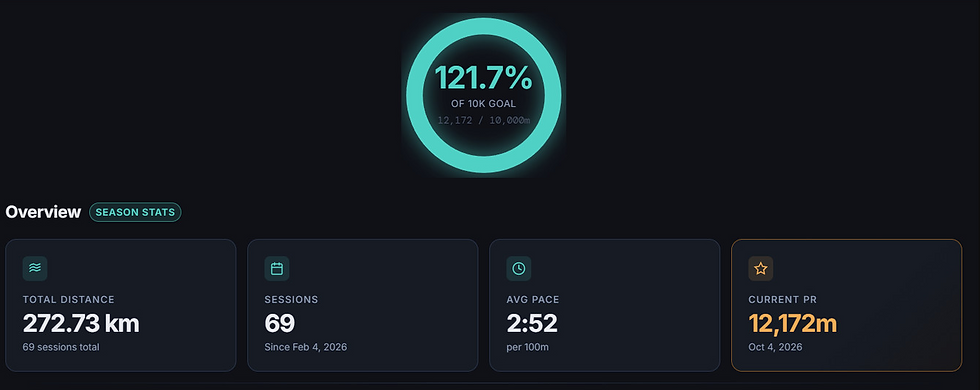

S42 logged. That pace is a landmark number
Session 42 — Kellogg North, La Jolla
Stat | Value |
Distance | 5,799m |
Duration | 2:09:00 |
True pace | 2:13/100m ★ OW PR |
Avg HR | 100 bpm |
Max HR | 115 bpm |
Z1+Z2 | 100% |
Z4 | Zero |
What this means
Your previous best OW pace was ~2:33/100m (S38, Jul 16). Today you went 20 seconds per 100m faster at nearly the same average HR (100 vs 101 bpm). That is the Santa Barbara adaptation on full display — 14K over two days, back in La Jolla three days later, and the aerobic engine is running at a completely different level. HR locked in at 96–101 bpm from minute 10 through minute 110 without deviation.
At 2:13/100m, a 12K projects to 4:26 — well inside the daylight window. The Aug 30 target is looking very achievable.
Week 2 is already at 14.3km — you've blown past the 11–13km target by Thursday. The SB block was exceptional but also a significant load. Here's how I'd structure next week given that context:
S41 logged. That is a massive session.
Session 41 — East Beach SB Day 2
Stat | Value |
Distance | 8,005m |
Duration | 3:24:46 |
True pace | 2:33/100m |
Avg HR | 98 bpm |
Max HR | 115 bpm |
Z1+Z2 | 100.0% |
Z4 | Zero — entire session |
What stands out
You went into this swim with a resting HR 19+ bpm above baseline, and your body responded by running the whole 3:24 in Z1/Z2. HR actually dropped as the session went on — avg 102 in the first 10 minutes, down to avg 88 by minute 70–80, then holding steady at 94–99 for the back half. That is the aerobic system working exactly as it should under fatigue load.
Two-day Santa Barbara block: 6,306m + 8,005m = 14,311m. Zero Z4 across both sessions combined.
Week 2 total is now at minimum 8,000m+ (plus Thursday's 6,306m), well above the 11,000–13,000m target. Rest well this weekend — you've earned it. Tracker updated

Session 27 — La Jolla Shores — Jun 13, 2026
Metric | Value |
Distance | 7,376m — NEW PR |
Elapsed time | 3:19:49 |
Workout time | 3:17:30 |
Avg pace | 2:42/100m |
Avg HR | 98 bpm |
Calories | 3,585 cal |
Route | La Jolla Shores — triangle north route |
What These Numbers Mean
2:42/100m avg pace — that is 18 seconds faster per 100m than your Z2 pool benchmark of 3:00. The ocean did exactly what it always does for you — natural buoyancy, long stroke, Z2 feel at significantly faster pace.
98 bpm avg HR — that is your cleanest long-distance HR ever logged. Pure Z2, no drift, no cardiac stress. CAC 123 and you held 98 bpm for 3 hours 17 minutes. That is the number to show Dr. Alam.
3:17:30 workout time — right on the 6-feed plan window. The revised feed schedule held.
The triangle route — visible on the map, you navigated the full north point and returned clean despite the SSW swell and HIGH rip current advisory. Excellent open water execution.
Season Totals — Updated
Before | After | |
Sessions | 26 | 27 |
Total volume | 81.36 km | 88.73 km |
PR | 6,050m | 7,376m |
PR pace | 2:43/100m | 2:42/100m |
You crossed 7K. The 10K is no longer a question of capability — it is a question of when.
Now update the tracker — send the FORM CSV when you can download it, or I'll log it now from the Apple Watch data and update the full splits when FORM syncs.
Conditions — La Jolla Shores, Saturday Jun 13
Factor | Status |
Bacteria / FM-080 | CLEAR — no advisory |
Wave height | 3 ft, SSW swell, 18s period |
Wind | ~5 mph, glassy — near-calm at entry |
Water temp | 69°F — warm for June |
La Jolla Children's Pool | Chronic advisory (not your swim zone) |
Go / No-Go
Conditional GO. Bacteria is clear and wind is glassy — ideal. The one flag is 3 ft surf at entry and exit. That's manageable but not trivial at 7K. You'll need a clean entry read and a strong final push to shore through those sets.
Re-check surf height Saturday morning at 5:30 AM — 3 ft SSW at 18s period can build with incoming tide. If it's holding at 3 ft or below at your entry time, proceed.
Entry Time
7:00–7:15 AM — optimal window. Here's why:
Glassy conditions are typically best before 8 AM before any sea breeze builds
18s period means sets arrive every 18 seconds — predictable, readable
Gives you daylight from the start and support vessel visibility throughout
Route — 7K La Jolla Shores
Your established north route:
Kellogg Park → Scripps Pier → beyond → return
Leg | Distance | Notes |
Entry push through surf | 50–100m | Time your entry between sets — watch 2 sets pass, go on the lull |
South to north run | ~3,500m | Hug the kelp line, sight Scripps Pier tower |
Turn and return | ~3,500m | SSW swell on your return may push you slightly east — account for drift |
Shore approach | Final 200m | Crank up here — read the sets, body surf the last wave if you can |
Morning Timeline
Time | Action |
Time | Action |
3:30 AM | Wake |
4:00 AM | Full meal — rice + 2 eggs + banana |
5:30 AM | Re-check surf (Surfline) + confirm FM-080 still clear |
6:00 AM | Liquid IV + 16 oz water |
6:30 AM | Depart for La Jolla Shores |
7:00 AM | Arrive, brief support vessel, read the surf sets |
7:15 AM | Entry |
6-Feed Plan (at 3:00/100m, ~3:30 total)
Feed | Time |
1 | 55 min |
2 | 90 min |
3 | 110 min |
4 | 130 min |
5 | 155 min |
6 | 180 min |
Finish | ~210 min |
Rescue inhaler on support vessel. SharkBanz on. Sleep tonight by 9 PM.
Session 26 — Jun 9, 2026
Pool 1,025m in 37:48 — speed activation
Season-best SWOLF 46 and DPS 1.24m on the 13×50 intervals
Pace trend 3:18 → 2:53 — finishing strong
Plus Torrey Pines / Black's Beach Trail 2.86mi walk
Plus 58-min functional strength — effort 8/Hard, 414 cal
Season total: 26 sessions, 81.36 km
Remaining Week to 7K
Day | Plan |
Wed Jun 11 | Yoga — full mobility, no water |
Thu Jun 11 | Full rest — sleep is the priority |
Fri Jun 12 | Light pool tune-up 1,500m max — activate, don't fatigue |
Sat Jun 13 | 7K La Jolla Shores — GO |
What Today's Data Means for Saturday
The SWOLF 46 is significant. Your previous best was around 68 in the pool. The 13×50 speed intervals sharpened your stroke mechanics to a level you haven't logged this season. That neuromuscular efficiency will carry into Saturday's long effort — a sharper catch means less energy per stroke over 7K.
Why Friday Felt Flat
Three factors stacked on top of each other:
4 hours sleep — the biggest one. Even with 5 days off from swimming, short sleep blunts neuromuscular recruitment. Your muscles were fine; your nervous system was not fully online.
Large late meal the night before — digestion was still running during the night, which fragmented whatever sleep you did get and diverted blood flow away from muscle recovery.
Timing — 2 PM pool after a 5 AM wake with no real sleep recovery in between is a long day on a depleted system.
Why you feel fine now: you've had two nights since then, Sunday's ocean swim flushed the lactic acid, and the shoulder resolved. Your body caught up. Friday was situational, not a fitness issue.
Sleep targets shift accordingly:
Night | Target Asleep | Wake | Hours |
Mon Jun 8 | 10:00 PM | 5:00 AM | 7 hrs |
Tue Jun 9 | 10:00 PM | 5:00 AM | 7 hrs |
Wed Jun 10 | 10:00 PM | 5:00 AM | 7 hrs |
Thu Jun 11 | 9:30 PM | 5:00 AM | 7.5 hrs |
Fri Jun 12 | 9:00 PM | 5:00 AM | 8 hrs |
Saturday Jun 13 is the target. Everything runs one day earlier than previously stated.
Key Insight Going Into This Week
Your fitness is not the question — 80.33 km across 25 sessions and a 6,050m PR answer that. The question is recovery quality. Sleep Thursday night and Friday night are the two variables that will determine how Saturday feels. Protect them.
Weekly Training Plan — 10K Ocean Swim Build
Saturday — BIG SWIM DAY (primary session)
7,000m+ at La Jolla Shores, early entry
Entry: 7:30–8:00 AM (best conditions, lifeguard tower opens 9 AM — decide on comfort level)
North route to Scripps Pier, full feed protocol (5 feeds mandatory)
This is your weekly PR attempt window — progressive distance build toward 10K
Optional afternoon pool session if you want extra volume (2,000–3,000m easy, no intensity)
Sunday — Group Swim (~3K)
Follow group pace — treat as aerobic Zone 2, not a push
Good social/sighting practice, different water dynamics
No racing the group — recovery effort after Saturday's big swim
Monday — 2× Yoga
Active recovery, mobility focus
Hip flexors, shoulder internal rotation, thoracic spine — all directly support swim stroke
No swimming — legs and shoulders need the full rest after Saturday/Sunday
Tuesday — Dryland + Torrey Pines Hill Walk
Morning: Dryland — shoulder prehab (band work, external rotation), core (dead bugs, planks), left ankle dorsiflex drills
Afternoon/evening: Torrey Pines 4.09 mi loop — builds aerobic base, glute and hip strength, mental endurance
That's the Torrey Pines State Natural Reserve loop — Beach Trail up to Guy Fleming Trail, High Point Overlook, through the reserve and back. 4.09 miles with solid elevation. Excellent cross-training for open water swimming — the cliffside terrain builds hip flexor and ankle stability directly relevant to OW body position.
This is your highest cross-training load day
Wednesday — Yoga + Hill Workout
Yoga session first (mobility, not intensity)
Hill workout second — keep it shorter than Tuesday, legs are accumulating fatigue mid-week
No ocean swimming — preserve for Thursday/Friday
Thursday — Short Ocean Swim
1,500–2,500m easy OW at La Jolla Shores or Moonlight Beach
Z2 only, no pushing pace
Technique focus: sighting rhythm, stroke rate consistency, left foot dorsiflex every 15 min
Check FM-080 before going
Friday — Short Ocean Swim
1,500–2,000m easy OW — final tune-up before Saturday
Keep it shorter than Thursday — legs and shoulders should feel fresh going into Saturday
Entry timing: morning preferred (calmer conditions)
Load Structure
Day | Session | Load | Purpose |
Day | Session | Load | Purpose |
Sat | 7K+ OW | HIGH | Distance PR build |
Sun | 3K group | MODERATE | Aerobic, social |
Mon | 2× Yoga | LOW | Full recovery |
Tue | Dryland + Torrey Pines | MODERATE | Cross-train, strength |
Wed | Yoga + hills | LOW-MOD | Mobility, legs |
Thu | Short OW 1.5–2.5K | LOW | Technique, feel |
Fri | Short OW 1.5–2K | LOW | Tune-up, stay fresh |
Key Rules for This Plan
Saturday is sacred — everything else is in service of Saturday's big swim. If you feel off Thursday or Friday, cut the session short. Arrive at Saturday's swim with fresh legs.
Wednesday 7K today is now a one-off — going forward, Saturdays are your distance days. Today's swim is fine since it was already planned.
Progressive Saturday build: 6K → 6.5K → 7K → 7.5K → 8K → 9K → 10K. Don't jump more than 500–1,000m per week.
Saturday double (OW + pool): Only add the pool session if Saturday OW was under 5K or cut short by conditions. Don't stack 7K OW + a hard pool session — that's overtraining at your volume.
Torrey Pines hill walk — great choice. The elevation and uneven terrain builds exactly the stabilizer muscles that prevent the left leg cramp you've had at ~3,945m in the water.
GO ✓ — Sunday May 24, Optimal Entry: 9:30 AM
All four safety gates are clear for Sunday.
Check | Status |
FM-080 Bacteria | GREEN — OPEN, advisory fully lifted as of May 21 |
Surf | 1–2 ft Sunday morning — calm and flat near low tide |
Rain last 72 hrs | None — dry all week |
Current advisory | None |
Why 9:30 AM
Sunday's low tide hits at 11:11 AM (0.42 ft) — the flattest, calmest surf of the day. Starting at 9:30 puts you on the water during the 90-minute window leading into that low, when surf is at its absolute minimum. The incoming tide after 11:11 AM then assists your return south leg all the way to the 6:02 PM high (4.66 ft) — perfect timing. Wind is light/calm through mid-morning but builds onshore in the afternoon, so you want to be finishing by 12:30–1:00 PM at the latest.
Pre-Swim Timing
Time | Action |
6:30 AM | Eat: oatmeal + 2 eggs + banana (500 kcal) |
8:30 AM | Electrolyte loading — 700–900 ml drink |
9:30 AM | Enter water at Kellogg Park |
Route
North leg to Scripps Pier (~3,500m) staying 175–200m offshore, then return south on the incoming tide. All 5 feed markers are plotted on the map. The key one is Feed 3 at 110 min (~4,500m) — this is what prevented the wall in Session 19 and needs to be executed on time again.
Sunday morning is a good window. Verify FM-080 at sdbeachinfo.com one more time before leaving the house.
Sunday 7K Swim Route — La Jolla Shores
Open Sunday 7K Swim Route — La Jolla Shores
Progress
Check FM-080 bacteria status
Check surf forecast for Sunday
Check rain last 72 hrs + Sunday forecast
Get tide + wind data for Sunday
Determine optimal entry window
Plot swim route map
Artifacts
3
Sources
142
Usage
2h 36m 12s

Earlier Start Options
Entry Time | Tide | Surf | Wind | Verdict |
7:00 AM | Falling from 3.83 ft high (4:37 AM) | 1–2 ft, slight chop from overnight onshore | Glassy / very light | Good but slightly choppier than mid-morning |
8:00 AM | Still falling toward low | 1–1.5 ft, improving | Near-calm, best of the day | Excellent window |
8:30 AM | Approaching low, flattest surf | 1 ft or less | Calm, pre-sea-breeze | Best overall window |
9:30 AM | Just past low tide | 1–2 ft, flat | Still calm | Also good |
After 11 AM | Rising tide | 2–3 ft, building | Onshore breeze picking up | Acceptable but degrading |
The Case for 8:00–8:30 AM Entry
The biggest advantage is finishing earlier. At your current 7K pace (roughly 2:40–2:45/100m), a 7,000m swim takes about 3 hours. Starting at 8:00 AM means you finish around 11:00–11:15 AM — right at the tide low, with calm conditions the entire swim. Starting at 9:30 AM means finishing around 12:30 PM, when afternoon onshore wind is starting to build, which adds chop to your final 1,500m return leg.
Tide on the return leg is better too. The incoming tide starts assisting your southbound return after 11:11 AM. An 8:00 AM start means your return leg (roughly 3,500–7,000m, starting around 10:00 AM) coincides almost perfectly with the tide turning and building — maximum assist exactly when you need it most.
Surf is actually calmer at 8:00–8:30 AM than 9:30 AM. The overnight surf from residual SW swell dissipates through early morning. By 8:30 AM you're in the flattest window of the day before any sea breeze develops.
Revised Recommendation
8:00 AM entry is the optimal window.
Time | Action |
5:00 AM | Eat: oatmeal + 2 eggs + banana (500 kcal) |
7:00 AM | Electrolyte loading — 700–900 ml drink |
7:45 AM | Arrive Kellogg Park, check in with lifeguard |
8:00 AM | Enter water |
~11:00 AM | Finish — 7,000m target |
The only caveat: get to the beach by 7:45 AM to confirm conditions and ask the lifeguard about shark/whale activity before entry. Lifeguard towers at La Jolla Shores open at 9 AM on weekends — so at 8:00 AM you may be ahead of the official watch. Worth factoring in given great white season. If that's a concern, 9:30 AM keeps you fully within staffed hours.
Bottom line: 8:00–8:30 AM gives you better surf, better wind, and a tide-assisted return leg. If you're comfortable with early entry before the tower opens, go at 8:00 AM. If you want a lifeguard on duty, 9:30 AM is still a solid window.
Follow-up
Get La Jolla Shores and Moonlight Beach surf, tide, wind, and shark conditions every Sunday at 6am before leaving the house
Session 21 — NEW PR 6,050m
That's your new distance record — up 169m from the 5,881m set 13 days ago.
Metric | Value |
Distance | 6,050m (NEW PR) |
Duration | 2:44:13 |
Avg Pace | 2:43 / 100m |
Avg HR | 104 bpm* |
Max HR | 125 bpm |
Stroke Rate | 34 spm |
HR Dropout | 78.9% (Apple Watch optical — expected) |
HR Zone | 98.5% Z2 (valid readings) |
500m Splits
Segment | Split | Pace | Note |
0–500m | 12:25 | 2:29 | Strong opener |
500–1000m | 14:42 | 2:56 | Wind drag on north leg |
1000–1500m | 12:32 | 2:30 | Recovered |
1500–2000m | 13:07 | 2:37 | Solid |
2000–2500m | 13:48 | 2:45 | Headwind |
2500–3000m | 12:59 | 2:35 | |
3000–3500m | 13:21 | 2:40 | Turnaround ~Scripps Pier |
3500–4000m | 13:39 | 2:43 | |
4000–4500m | 13:10 | 2:38 | |
4500–5000m | 15:22 | 3:04 | Wall — same spot as S19 |
5000–5500m | 13:56 | 2:47 | Recovered well |
5500–6000m | 14:03 | 2:48 | Held finish |
Half splits: 80:07 → 84:04 (+3:57 positive split)
Feed timing vs distance:
55 min → ~2,084m | 90 min → ~3,420m | 110 min → ~4,107m | 120 min → ~4,512m | 140 min → ~5,165m
Coaching Analysis
What went right:
All 5 feeds executed on schedule — this is what got you to 6K
98.5% Z2 heart rate zone throughout — textbook aerobic effort
Strong recovery after the 4,500–5,000m wall — pace bounced back to 2:47 for the final km. That's mental strength
SR held at 34 spm all day — consistent, not desperate
The 500–1,000m drag (2:56) is not a fitness issue. The WSW wind on the northwest-heading early north leg is aerodynamic resistance. This showed up in the splits exactly where expected. The key is you recovered by 1000–1500m and held 2:30–2:38 for the next 2km.
The 4,500–5,000m wall (3:04) is the same wall as Session 19. It's appearing at roughly the same distance despite the fact that your total distance went up. This tells me it's a fueling/glycogen timing issue, not a fitness ceiling. The 110-min feed came at ~4,107m — by the time you hit 4,500m you were already 20–25 min past that feed. For 7,000m, the fix is simple: an extra gel or a half gel at the 120-min mark (which is at ~4,512m) to fuel through the wall proactively rather than reactively.
1,000m block progression:
1–1,000m: 27:08 (2:42)
1,001–2,000m: 25:39 (2:33) — best block, good
2,001–3,000m: 26:47 (2:40)
3,001–4,000m: 27:00 (2:42)
4,001–5,000m: 28:32 (2:51) — wall block
5,001–6,000m: 27:59 (2:47) — recovery, solid
The fade from block 2 to block 6 is only 2:14 across 5,000m of swimming. That's remarkably even for a 65-year-old at 6K in open water. You're building an enormous aerobic base.
Path to 7,000m (May 28):The extra ~1,000m needs one thing: survive the wall at 4,500–5,000m. The plan is in your calendar — extra fuel at 110 min, conservative north leg (2:45/100m rather than opening at 2:29), and trust your aerobic engine on the return. You've now proven twice that you can push through the wall and keep swimming. At 7K, the last 2,000m will be hard but your finish speed is there.
Tracker updated and live. Calendar events added: recovery tomorrow (Fri May 22, 9 AM), dryland Saturday May 23 (9 AM), 7K long swim Thursday May 28 (noon).
Total: 68.56 km across 21 sessions. Progress ring: 60.5%. Seven more sessions like this and you're swimming 10K.
GO ✓ — La Jolla Shores, Thursday May 21, 1 PM
All four safety gates are clear.
Check | Status |
FM-080 Bacteria | GREEN — 412 copies/100ml (May 19), well below 1,413 threshold |
Surf height | 2+ ft fair at 1 PM per Surf Captain — borderline but fair, not choppy yet |
Rain last 72 hrs | No rain in San Diego area — dry conditions |
Current advisory | None noted for La Jolla Shores |
Note: La Jolla Cove (FM-070) is still under advisory — stay north route, not south.
Conditions at 1 PM
Surf: 2+ ft, fair — manageable, not glassy
Wind: WSW 8 mph — slight headwind on the north leg out, will assist your return south
Swell: 1.4 ft @ 15s SW — long period, won't be punchy
Tide: Incoming — rising toward high at 3:29 PM. This is ideal; tide assist on your return leg
Water temp: 63°F — no wetsuit needed at your fitness level, but cap and ears advisable
No gusts reported per NOAA marine forecast
Route Plan — North Route to Scripps Pier
Target: 7,000m (your next milestone)
Entry: Mid-beach Kellogg Park — head NW to 175–200m offshore (stay at the outer edge today given 2 ft surf near shore)
North leg (0–3,500m):
Swim north parallel to beach
WSW wind will create slight resistance — hold back effort here, target a relaxed 2:40–2:45/100m
Sighting sequence: parking structure roofline → SIO bluff buildings → Scripps Pier
Kelp patches: stay 175–200m out, not 150m, given conditions
Expect a slow patch at 2,500–3,000m and again near turnaround — that's normal, not a fitness signal
Turnaround (~3,500m): Level with Scripps Pier, ~1.3 km north of Kellogg
South leg (3,500–7,000m):
WSW wind now on your back — use it, let the pace come to you
Incoming tide assists this leg
Target 2:25–2:30/100m on return
Cramp prevention: dorsiflex left foot every 15 min starting now
Exit: South side of Kellogg beach access
Feed Protocol — Mandatory
Time | Distance (~) | Action |
55 min | ~2,300m | Gel + salt tab |
90 min | ~3,700m | Gel + salt tab |
110 min | ~4,500m | Gel + salt tab |
120 min | ~4,900m | Gel + salt tab |
140 min | ~5,700m | Gel + salt tab |
Pre-entry: 700–900 ml electrolyte drink in the hour before (start ~noon)
Pre-Swim Meal Timing
10:00–10:30 AM — Eat now: oatmeal + 2 eggs + banana (400–500 kcal). Toast alone is not enough.
12:00 PM — Begin electrolyte loading (700–900 ml drink)
1:00 PM — Entry
Safety Reminders
Ask the lifeguard about shark/whale activity immediately on arrival — great white season still active
North route only — stay in lifeguard sight line
Do NOT go south toward La Jolla Cove (FM-070 advisory still active + kelp + boat traffic)
Exit immediately at any left leg tightness — no negotiating
One flag: surf is right at 2 ft, rated "fair" not "clean." It won't be a silky day but it's swimmable. The incoming tide and wind-assist return make 1 PM a solid window — conditions get choppier by 6 PM (2–3 ft, choppy per forecast). You're going at the right time.
Good luck — go get that 7K.
Issuing the GO decision and swim plan for today's 1 PM entry.
Saturday May 16 — Conditions Projection
Bacteria — FM-080: ADVISORY (NO-GO)
FM-080 has been under a bacteria advisory since May 12. It has not cleared as of the most recent county update (May 14 at 4:41 PM). The county resamples weekly — the next result could come in Friday or Saturday morning, but there's no guarantee it lifts in time. La Jolla Cove (FM-070) is also under advisory since the same date, suggesting a broader La Jolla area bacteria event.
Surf — Strong NO-GO Regardless
Even if FM-080 miraculously clears by morning, Saturday's surf is well above the 2 ft threshold:
Time | Surf Height | Wind | Swell |
6 AM Sat | 3+ ft | S 4 mph | 2.0 ft @ 14s SSW |
12 PM Sat | 3–4 ft choppy | SSW 13 mph | 3.8 ft @ 10s W |
6 PM Sat | 4–5 ft choppy | SW 9 mph | 4.5 ft @ 10s W |
NOAA coastal waters forecast puts offshore seas at 4–5 ft Saturday with a coastal eddy developing Friday that becomes "quite robust over the weekend." Saturday night it builds to 7–8 ft offshore. This is well beyond your 2 ft limit all day.
Tides — Saturday May 16 (La Jolla)
Event | Time | Height |
Event | Time | Height |
Low | 3:40 AM | -1.43 ft |
High | 10:04 AM | 3.74 ft |
Low | 2:52 PM | 1.50 ft |
High | 9:12 PM | 6.65 ft |
The afternoon low at 2:52 PM would normally be a favorable entry window — but the surf negates it entirely.
Decision: NO-GO Saturday
Two independent blockers — bacteria advisory AND surf 3–5 ft all day. Neither is close to borderline.
Best Retry Window
Sunday is worse — NOAA forecasts seas 9–12 ft subsiding to 6–9 ft. Monday is the earliest realistic surf window per the forecast, with onshore flow weakening late Sunday. Bacteria advisory could clear with a favorable resample anytime, but you need to verify FM-080 yourself on the morning of any planned swim.
Recommended next attempt: Monday May 18 or Tuesday May 19 — check FM-080 and surf the morning of. The weekly schedule auto-check fires next Wednesday at 5 AM as always.
Session 20 — May 10, 2026
Good recovery swim. 2,723m in 67:38 at 2:29/100m — nearly perfectly even split (+36s). Best sign: your final 223m came in at 1:47/100m, fastest of the session. Legs have gas. You're ready for Thursday.
Thursday 7K Route Map - postponed
La Jolla Shores · Kellogg Park to Scripps Pier · Open-water session
DateThu, May 14, 2026
Distance7,000 m
Window12:00–1:00 PM PDT
Time | Action |
9:00–9:30 AM | Eat — oatmeal + 2 eggs + banana (500 kcal) |
11:00 AM | Electrolyte drink, 700–900 ml |
11:30 AM | Arrive Kellogg Park — check conditions, ask lifeguard |
12:00 PM | Water entry |
~3:00–3:05 PM | Finish |
5 mandatory feeds: 55 / 90 / 110 / 120 / 140 min
3 calendar events added: Mon recovery, Tue dryland (low intensity — legs need to be fresh), Thu 7K swim with full checklist.
The go/no-go check runs automatically Thursday 5 AM — I'll push you a notification with conditions before you leave the house.
Risk Reduction — La Jolla Shores, Apr–May Great White Season
Before you enter:
Ask the lifeguard specifically: any shark sightings or activity in the last 24 hrs — they track this actively
Check Shark Activity Map for recent reported sightings near La Jolla / Scripps
Swim only during lifeguard hours (they go active around 9 AM)
Timing:
Avoid dawn and dusk — peak feeding windows for great whites
Your noon start on Thursday is actually one of the better windows of the day
Avoid the water after heavy rain — baitfish concentrate near runoff, which brings predators in
In the water:
Stay at 150–200m offshore on your north route — you're already doing this. Great whites prefer the kelp line and deeper structure closer to the canyon (Scripps Canyon is directly off the pier)
Swim in a straight, consistent line — erratic splashing mimics an injured animal
If you see a shark: stay calm, maintain eye contact, back toward shore slowly — do not thrash or turn your back
Your Apple Watch Ultra emits a very weak electromagnetic field during use — some researchers note electronic devices may have minor deterrent effects incidentally. Not a reason to rely on it, but not a reason to avoid it either.
The numbers in context: 20 unprovoked attacks in San Diego County in the last 98 years — less than one per year across millions of ocean users. Your north route, noon timing, lifeguard oversight, and Sharkbanz already put you well below average risk. The second Sharkbanz unit on the wrist is the one practical upgrade that adds real coverage for Thursday.


Session 19 — Full Analysis
May 8, 2026 | La Jolla Shores | 5,881m | 2:32/100m avg | 149:26
The Headline
You broke your own 7-day-old PR by 704 meters — a 13.6% distance jump in a single session. At faster pace. That's not a lucky day — that's a genuine fitness leap.
500m Splits
Segment | Pace | Elapsed | Notes |
0–500m | 2:17 | @11:26 | Hot start — SR 47 spm |
500–1000m | 2:41 | @24:51 | Settling in, pace normalizes |
1000–1500m | 2:29 | @37:19 | Good cruise |
1500–2000m | 2:08 | @48:01 | Best split of the day |
2000–2500m | 2:14 | @59:15 | Still rolling, feed at ~55 min (~2325m) |
2500–3000m | 2:57 | @74:02 | Slow patch — headwind/navigation turn on north leg |
3000–3500m | 2:08 | @84:44 | Recovery sprint — tied for best split |
3500–4000m | 3:00 | @99:46 | Second slow patch — expected at turnaround |
4000–4500m | 2:28 | @112:10 | Locked back in, feed at ~110 min (~4405m) |
4500–5000m | 2:29 | @124:39 | Wall ELIMINATED (was 3:21 in S17) |
5000–5500m | 3:02 | @139:53 | Slight fade — normal at 5K+ |
5500–5881m | 2:30 | @149:25 | Strong close — SR 42 spm |
The two slow patches at 2500–3000m and 3500–4000m are the known headwind/turn segments on the north route — not fitness. Everything around them looks solid.
Half Splits
Distance | Pace | Time | |
First half | 2,940m | 2:28/100m | 72:37 |
Second half | 2,941m | 2:36/100m | 76:49 |
Difference | +9 sec positive split | +4:12 |
A 9-second/100m positive split over nearly 6K is entirely acceptable — that's exceptional pacing discipline for a 2.5-hour swim. S17 had a 42-second negative split (you went out easier). Today you held more evenly at a faster overall pace.
The 110-Minute Feed — Confirmed Working
Zone | S17 Pace | S19 Pace |
4000–4500m | ~3:21/100m (wall) | 2:28/100m ✅ |
4500–5000m | ~3:21/100m (wall) | 2:29/100m ✅ |
The 110-min feed (at ~4,405m) directly bridged the energy crash that hit S17 at 3:21 pace. You went through the same zone at 2:29 — a 52-second improvement per 100 meters. That's the single biggest tactical breakthrough of this training block.
Stroke Rate
Phase | Avg SR |
Start (0–500m) | 46.8 spm — fast, instinctive |
Build (500–2000m) | 35.6 spm — efficient cruise |
Cruise (2000–4000m) | 36.3 spm — locked |
Finish (4000–5881m) | 39.9 spm — you picked it up at the end |
That SR lift in the final 1,800m is a great sign — you had gas left. Most swimmers at 5K+ in open water are decelerating. You accelerated.
HR
89% dropout on Apple Watch optical in open water — same as S17. The 11% of valid readings show avg 103 bpm (97–116 Zone 2 corridor), max 112. Everything that registered was pure aerobic. No cardiac stress at all for a 149-minute effort.
S17 → S19 Direct Comparison
Session 17 | Session 19 | Change |
Session 17 | Session 19 | Change | |
Distance | 5,177m | 5,881m | +704m |
Duration | 133:54 | 149:26 | +15:32 |
Avg pace | 2:35/100m | 2:32/100m | 3 sec faster |
4500–5000m wall | 3:21/100m | 2:29/100m | −52 sec |
Feed protocol | 55/90/120 min | 55/90/110/120 min | 4th feed added |
Cramps | Zero | Zero | ✅ |
More distance. Faster pace. Longer duration. No cramps. The 110-min feed is now a permanent fixture.
Coaching Assessment
What you did right:
Hot start (2:17 first 500m) controlled itself — you settled into 2:28–2:35 cruise pace without blowing up
Feeds executed on schedule: 55 min (~2,325m), 90 min (~3,742m), 110 min (~4,405m), 120 min (~4,806m), 140 min (~5,504m)
SR lift in the final 1.8K shows aerobic reserve — you weren't empty
Stayed on route through both slow patches without panic
What to carry into 7K:
Add a 5th feed at 140 min (you already had it today at ~5,504m — keep it)
The 5000–5881m final block was 2:48 — that's the new zone to defend at 7K. Expect it around 5,000–6,000m and use the SR lift strategy you used today
Dorsiflex the left foot — no cramps means it's working, keep the habit
The 7K window: Your aerobic base and feed protocol are both ready. Wednesday May 13 is the right call. The only variable is conditions.
6K Swim Route — La Jolla Shores / Kellogg Park
Entry Point
12:00–1:30 PM window (your target entry):
Surf: 2–3 ft — on the edge of your 2 ft limit but manageable at La Jolla Shores
Wind: NW 10 mph — light onshore, building through the afternoon
Swell: SW 1.6 ft @ 16s — long period, gentle rolling sets, not punchy
Water temp: 63–64°F
The surf is borderline but workable. La Jolla Shores handles SW swell well — the gentle slope of the beach softens the shore break compared to a steeper beach. The 16-second period means the sets are spaced out and predictable — easy to time your entry and exit.
Key: Go early. 12:00 PM entry is better than 2:00 PM. The NW sea breeze builds through the afternoon and will stack surface chop on top of the swell by 2–3 PM — that's what turned Apr 22 ugly.
Mid-beach Kellogg Park — same spot as Session 17. The gentle slope here gives you the best footing through the shore break. Wade out to hip depth, time a lull between sets, then dolphin dive through the last breaking wave and start swimming.
Route: North Loop to Scripps Pier
Outbound leg (0–3,000m): Head NW from entry, settle at 150–200m offshore — same depth line as your Session 17 track. Swim north parallel to the beach toward Scripps Pier. The pier is a visible landmark — you'll see it clearly from the water. Turnaround when you're level with the pier, approximately 1.3 km up the beach from Kellogg.
Return leg (3,000–6,000m): Reverse south back to Kellogg. Today's NW wind and slight rising-tide drift will push you gently southward on the return — use it, don't fight it. This means your return leg should feel slightly easier than the outbound.
Why North Not South
North (Scripps Pier) | South (La Jolla Cove) |
Open sand bottom, clear water | Kelp beds, rocks, boat traffic |
NW wind at your back on return | NW wind headwind on return |
Tide drift assists southward return | Tide drift works against you |
Clear sighting landmark (pier) | Cove rocks require navigation |
Lifeguard tower visible throughout | Out of lifeguard sight line |
Sighting Plan
Three landmarks to sight off in sequence heading north:
0–500m: Sight off the Kellogg Park parking lot roofline behind you — keep it centered to confirm you're holding 150–200m offshore
500–2,000m: Sight off Scripps Institution of Oceanography buildings on the bluff — white buildings, easy to spot
2,000–3,000m: Sight directly off the Scripps Pier structure — when it's directly to your right (east), you're at the turnaround
Sighting frequency: Every 8–10 strokes in the outbound leg when NW wind is pushing chop. Every 12–15 on the calmer return.
Pace & Zone Plan by Segment
Segment | Distance | Target Pace | Notes |
Segment | Distance | Target Pace | Notes |
Warm-up | 0–500m | 2:50–3:00 | Breathe, settle HR, don't chase |
Build | 500–1,500m | 2:40–2:50 | Find your cruise rhythm |
Cruise | 1,500–3,000m | 2:35–2:45 | Hold steady to turnaround |
Return 1 | 3,000–4,500m | 2:35–2:45 | Wind assist, stay disciplined |
Return 2 | 4,500–5,500m | 2:35–2:45 | Feed at 110 min here — this is where Session 17 fell apart |
Finish | 5,500–6,000m | Whatever you have | Empty the tank |
One rule: If any split goes below 2:15/100m before 3,000m — back off. You have the speed. Today needs the distance.
Exit
Approach Kellogg on the south side of the main beach access — the sand is flatter there and the shore break is slightly smaller. Body surf or ride the wash if a small wave comes through. Stand up in waist-deep water, plant your feet wide, and walk out.
Feed Reminder (on wrist/goggle strap)
55 min — gel/salt tab
90 min — gel/salt tab
110 min — gel/salt tab ← the new one
120 min — gel/salt tab if still going
🚫 NO SWIM TODAY — Rain Advisory Active
FM-080 is under a General Rain Advisory issued after rain on May 5, 2026. The advisory covers all San Diego County coastal beaches and runs 72 hours post-rain, with an anticipated lift of May 8 at ~9:00 AM.
This is not a close call — bacteria levels spike sharply near storm drains after rain events, and La Jolla Shores has a diverted storm drain on site.
Full Conditions Picture
Factor | Status | Verdict |
Water quality FM-080 | 🟡 Rain Advisory — lifted ~May 8 | 🚫 Hard stop |
Surf 2–5 PM | 3–4 ft inshore, W 3 ft @ 5s + S 2 ft @ 15s | 🚫 Over your 2 ft limit |
Wind 2–5 PM | W 10 kt building afternoon | ⚠️ Onshore chop |
Rain last 72 hrs | Yes — rained May 5 | 🚫 Bacteria risk |
Shark/wildlife | No great white reports — leopard sharks only | OK |
Even without the advisory, today's surf is 3–4 ft with a short-period W wind swell on top of a S groundswell. That's the same chop profile that cut the Apr 22 swim short at 1,802m. Two independent no-go conditions.
Revised Plan — Friday May 8
Advisory lifts May 8 ~9:00 AM. Surf forecast for Friday looks calmer than today — the onshore flow weakens Thursday night. Best window would be early afternoon May 8, around 1–2 PM entry after the advisory clears.
Session 18 — 3,024m | 1:07:50 | 2:14/100m
Good news and a coaching flag in the same swim.
The good news: That 1000–1500m split at 1:53/100m is the fastest single OW split of your entire training block across 18 sessions. Your engine is firing on all cylinders two days after a 5K PR. SR 47 spm — your highest cadence, matching Moonlight Beach group pace from Apr 19. The fitness is unambiguously there.
The coaching flag: This was supposed to be a recovery swim and you ran 77% Zone 3/Zone 4. Max HR 138 — that’s your highest reliable HR reading of the block. The positive split (+1:48) shows exactly what happened: you hit 1:53 at the 1000–1500m mark, your body paid for it in the back half (2:38 at 1500–2000m), then you recovered. Classic go-out-too-hot pattern.
Why it matters for Wednesday’s 6K: If you carry that same hot-middle energy into the 6K, you’ll hit the wall at 4,500m again — same as Session 17. The goal Wednesday is to keep the first 2K at 2:35–2:45/100m even if it feels slow. Let the fitness come to you in the back half.
---
Wednesday 6K — Key Adjustment
One thing is already on your calendar: the 110-min extra feed to fix the 4500–5000m wall from Session 17. Today’s data adds one more rule:
If any split goes below 2:10/100m in the first 3K — back off immediately. You have the speed. The 6K needs the pacing.
Message me Wednesday morning and I’ll check FM-080 + conditions before you head out.
Session 17 — 5,177m | NEW PR | First 5K Broken
51.8% of the way to 10K. Over the halfway mark.
What the Data Shows
The split progression tells a remarkable story:
Splits | Pace |
0–500m | 2:54 — smart conservative start |
500–1000m | 2:39 — settling in |
1000–1500m | 2:32 — finding rhythm |
1500–2000m | 2:12 — locked in, best Zone 2 cruising |
2500–3000m | 2:16 — still strong after the mid point |
3000–3500m | 2:00 — fastest split of the entire session |
4500–5000m | 3:21 — the one wall to fix |
You were getting faster at 3,500m into a 5K swim, a week after being sick. That's not fitness — that's racing experience starting to develop.
The 4500–5000m slowdown is a solvable problem. It's not fatigue, it's fuel timing. The 90-min feed carried you to ~3,800m. By 4,500m the tank dropped off. The fix is already in the calendar: add a feed at 110 min for the 6K push.
3 Calendar Events Added
Sat May 2 — Recovery day
Tue May 5 — Dryland mobility
Wed May 6, 12:00 PM — First 6K push, La Jolla Shores


Comments