Chapter 1 – The Man Who Crossed the Border
There were only a few things I knew about my father growing up.
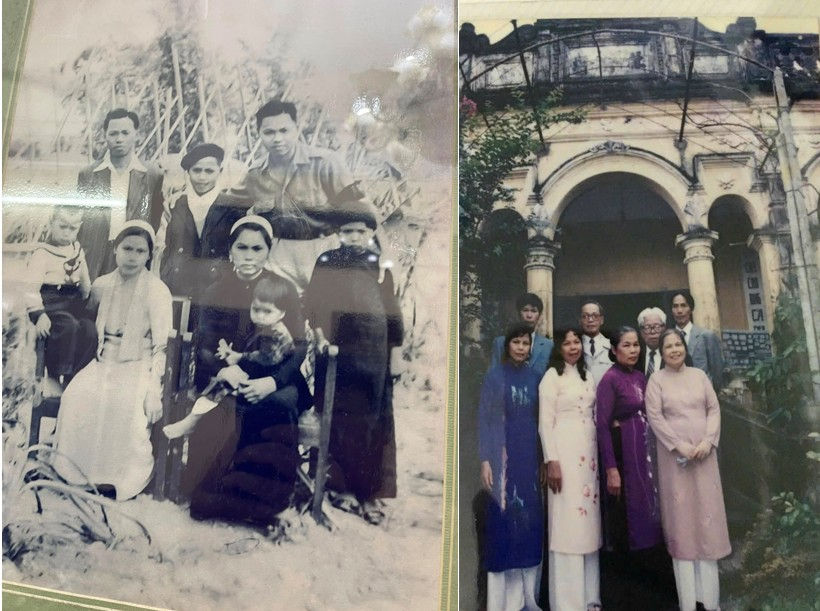
One was a photograph — grainy, black and white, the image worn at its edges as though time itself had been pressing against it for decades. In the picture, my grandfather sits in a sparsely furnished living room somewhere in Hà Nội, Vietnam, probably taken around 1975. Beside him are my three uncles, my father the oldest among them. His four younger sisters are absent from the frame. I used to study that photograph for long minutes as a child, looking for the man I was supposed to know, searching for something in the angle of a shoulder or the set of a jaw that might tell me who he was before he became my father — before he became the silence at the center of our family story.
The other thing I knew was a name: Lý Đông A.
An anti-communist intellectual. A revolutionary philosopher. A man who believed Vietnam could claim its own future — not under French colonial rule, not under the Communist movement Hồ Chí Minh was building, but through a Vietnamese humanism rooted in culture, spirit, and self-determination. The Communists killed him in 1947. He was thirty years old.
My father carried that name the way you carry a wound that has healed over but never fully closed. And to understand why my father eventually walked away from his own family — why he crossed a line that would separate him from his brothers, his parents, his entire world — you have to understand first the world that family came from. Because it was not a small world. It was not an ordinary one.
A Name Meaning Gold
My father was given the name Kim.
In Vietnamese, kim means gold. It is not a name chosen casually, not something given to a child by parents of modest means and modest expectations. It is a name that carries weight — the weight of a family's highest hopes pressed into a single syllable, placed on a child's shoulders at birth like a quiet instruction about what he was meant to become.
The man who gave my father that name was his grandfather — my great-grandfather — who served as the Governor of Vietnam under the French colonial administration. That is the line I come from on my father's side. Not a line of resistance fighters, not originally a line of revolutionaries, but a line of men who had learned to navigate colonial power at its highest levels, who had mastered French, who had administered provinces, who had sat across tables from European officials and managed, with great skill and great compromise, to hold positions of Vietnamese authority within a system designed to diminish it.
To be the Governor's grandson was to be born into a particular kind of expectation: that you would be educated, that you would be bilingual, that you would understand how power worked from the inside, and that you would use that understanding to protect and advance your family and, quietly, your people. The name Kim was the Governor's promise to the future — this child, gold, precious, durable, the most valuable thing we have, will carry us forward.
What the Governor could not have known, naming his grandson in that act of hope, was that the boy called Gold would one day run from Hồ Chí Minh's soldiers in the dark, escape across a border into China, survive a Japanese arrest, and ultimately leave everything his grandfather had built — the connections, the prestige, the social position accumulated across generations of careful navigation — behind him on the northern side of a line drawn at the 17th parallel.
Gold does not stay where it is placed. It moves. It ends up far from where it started.
Royal Blood, Rich Land
My grandmother was not a simple village woman either. She carried in her veins a connection to Bảo Đại — the last Emperor of Vietnam, the final ruler of the Nguyễn dynasty, the man who abdicated in August 1945 when Hồ Chí Minh's revolution swept through the country like a tide nothing could hold back. The precise nature of that kinship — whether by blood or by the intricate web of aristocratic alliance that Vietnamese imperial families maintained across generations — was not something spoken about plainly in our household. But it was understood. It was present in the way my grandmother carried herself, in the gravity she brought to a room, in the standards she held for her children as if they were accountable not only to her but to something older and larger than any of them.
So on one side of this family: the Governor's bloodline, a great-grandfather who administered provinces, who named his grandson Gold. On the other: a grandmother connected to the imperial Nguyễn dynasty, to the last man who sat on the Dragon Throne.
And the family was prosperous. Genuinely, substantially prosperous — with rice fields extending across generations, with the kind of wealth that was not counted in coins but in soil, in harvest, in the deference of neighbors and the weight of ancestral obligation. My grandparents lived not in poverty but in the quiet authority of a family that had built something durable across many decades.
That prosperity made what came next even more astonishing.
The Great Sacrifice
When Hồ Chí Minh rose to power in 1945, my family — like many educated, nationally conscious Vietnamese families of that era — did not see him first as a Communist. They saw him as a nationalist. A man who had spent decades abroad, who had petitioned the great powers, who had studied and organized and returned to his country with a singular purpose: to end foreign domination and give Vietnam back to the Vietnamese.
That vision resonated deeply with a family that carried royal lineage, a governor's legacy, and landowning pride — that had watched the French extract wealth from Vietnamese soil for generations, that had taught its children the names of Vietnamese heroes and the history of a civilization that predated any European empire. Hồ Chí Minh spoke the language of that pride, even if the ideology underneath it was something more complicated and, ultimately, something more dangerous.
And so my family made a decision that I still find difficult to fully absorb when I sit with it quietly: they gave away the land.
Not sold. Not transferred strategically. Given. The family's rice fields — the foundation of their prosperity, the inheritance of generations, the material expression of everything the Governor's lineage and my grandmother's imperial connection had accumulated — were surrendered in support of Hồ Chí Minh's movement and the promise of a free Vietnam. It was an act of faith so complete it could not be undone. A family that had once been wealthy became, by their own choice, a family that had chosen principle over property.
My grandmother, a woman connected by blood to the last Emperor of Vietnam, gave away the land of her ancestors so that Vietnam could be free. The grandson the Governor had named Gold watched it happen, and said nothing to stop it.
That is the family my father came from.
The Letter That Was Never Answered
But there was something Hồ Chí Minh knew — and that my family would only learn much later — that casts a long shadow over that sacrifice.
In 1945 and 1946, at the very moment Vietnam's independence was being declared and the French were preparing to return by force, Hồ Chí Minh wrote to President Harry S. Truman — not once, but multiple times. He wrote as the leader of a newly declared republic. He wrote invoking the language of the Atlantic Charter, of self-determination, of the very principles America claimed to stand for. He asked, plainly and urgently, that the United States not support France's return to Vietnam. He believed — based on what Franklin Roosevelt had said privately about colonialism, based on America's stated ideals — that there was a chance the most powerful nation on earth might intervene on the side of Vietnamese independence.
Truman never responded.
Not a refusal. Not a rejection. Silence. The letters went into American diplomatic files and stayed there while French warships moved toward Vietnamese ports. Cold War logic had already begun to reshape American priorities: France was a critical European ally needed to contain the Soviet Union, and French Indochina was a colonial matter the United States was not prepared to complicate. Vietnam's plea for support fell into the gap between American idealism and American geopolitics, and it was swallowed there without a trace.
When the French returned — when the tricolor flags were raised again over Vietnamese streets, when the colonial administration began reasserting its authority — my family understood, with terrible clarity, what Truman's silence had meant. They had given away their land for a free Vietnam. Hồ Chí Minh had asked America not to stand in the way. America had said nothing. And the French had come back anyway.
The disillusionment ran through my family like a crack through stone. It did not destroy their belief in Vietnamese independence — that conviction was too deep, too old, too tied to the Governor's legacy and the Emperor's blood. But it made the world more dangerous and more ambiguous than any of them had wanted it to be.
The Border Crossing
This is the story my grandmother never fully forgave.
Even before the French returned, while the Japanese still occupied Vietnam and the war in the Pacific was still being decided, my father — the boy named Gold, the Governor's great-grandson — was a young man burning with the ideals he had absorbed from Lý Đông A's movement. Lý Đông A had organized a network of nationalist Vietnamese youth who believed that Vietnam's independence could not be borrowed from any foreign power, not from the French, not from the Communists, not even from a sympathetic America. It had to be built from within.
One of those moments of action brought my father to a decision that would define him.
American military aircraft were being shot down by the Japanese over the mountainous terrain near the Vietnamese-Chinese border. Some of those pilots survived — parachuting into remote jungle and karst landscape, disoriented, cut off, unable to speak the language. Lý Đông A's network saw an opportunity: help find and rescue those pilots, guide them back across the border into Allied-controlled southern China, and in doing so forge a relationship with the Americans who might one day support Vietnamese independence. It was dangerous, idealistic, and completely characteristic of the man my father had chosen to follow.
My father crossed the border into China to help find those downed American pilots.
When my grandmother found out, the air went out of her world. She was a woman connected to imperial lineage, married into the Governor's family, a woman who had overseen a prosperous household and had already surrendered the family land in a single act of faith. She had given everything she could give. And now her eldest son — the one named Gold, the one on whom the most hope had been placed — had walked across an international border in the middle of a war, in service to a clandestine nationalist network, to rescue foreign soldiers.
He was arrested by the Japanese.
How long he was held, exactly, the family memory does not say with precision. But the detention was real — my father, held by the imperial force that occupied his homeland, paying the price for what he had attempted in pursuit of Lý Đông A's vision. And then, for reasons history did not fully preserve in our family's telling, he was released.
He came home.
But the man who walked back through the door was not the grandson the Governor had named Gold, not the obedient heir to a legacy of careful navigation through colonial power. He was someone who had already decided — in a Japanese detention cell near the Chinese border — that he would not live by fear. He had tested his own courage against the worst he could imagine, and he had survived. That changes a person in ways that no argument, no mother's grief, no family's accumulated authority can reverse.
My grandmother's disappointment was not ordinary maternal worry. It was the grief of a woman who had given away her land, who had watched the Governor's name used in service of ideals that kept pulling her firstborn son toward danger she could not protect him from. She had sacrificed the material world for an ideal. He had gone further: he had risked his body for one. And he would go further still
The Closing Net
By 1947, Hồ Chí Minh faced a stark strategic reality. The French had returned in full force. The resistance needed arms, organization, international support, and ideological unity. To get all of that — to transform a nationalist uprising into a war capable of defeating a European colonial power — he needed the backing of the global Communist network. He needed Moscow. He needed Beijing. And to secure that support, he needed to present a movement that was ideologically coherent, undivided, fully under Communist Party control.
That meant there was no longer room for Lý Đông A.
The two men had once occupied overlapping space — both nationalists, both committed to Vietnam's independence, both opposed to French colonialism. But Lý Đông A's vision of a third path, a non-Communist Vietnamese humanism, was now not merely a philosophical disagreement. It was a rival center of gravity for young Vietnamese intellectuals and activists — young men like my father, the Governor's great-grandson, the boy named Gold — who might otherwise fall in fully behind the Party. Hồ Chí Minh moved to eliminate that threat with the same quiet efficiency that revolutionary movements have always used to silence the voices that complicate their message.
He sent his forces to find Lý Đông A. They surrounded him.
My father was there — one of the young men who had organized under Lý Đông A's banner, who had crossed borders and survived Japanese detention for the ideals this man had given them. When the net closed, my father understood what was happening with a speed that only people who have already survived one arrest can manage. He had been held by the Japanese. He knew what it felt like when the walls of a situation begin to contract. He knew the difference between a moment that still has exits and a moment that does not.
He escaped.
The details of how — which road he took, who helped him, what he left behind in his flight — are the kinds of details that survived only in fragments, in the careful silences of people who understood that speaking too precisely about such things could still cost lives decades later. What I know is this: when Hồ Chí Minh's forces closed around Lý Đông A, my father — Kim, Gold, the great-grandson of the Governor — was not captured with him. He got out.
Lý Đông A did not. He was killed by the Communists in 1947.
My father carried that with him for the rest of his life — the weight of having escaped when his leader did not. The particular, complex guilt of the survivor who ran when running was the only honest option, who lived when living meant leaving someone behind. He never spoke of it directly, not in the stories that reached me. But it was there, in the shape of every decision he made afterward. Every choice my father made after 1947 was made by a man who knew exactly what it had cost to still be alive — and who understood, with the precision of someone who had twice stood at the edge of losing everything, that the name Gold carried a burden the Governor could never have anticipated when he bestowed it.
The Fracture
Between 1947 and 1954, my father built what looked from the outside like a conventional life. He married my mother. He studied dentistry at Hà Nội University and became a certified French Oral Surgeon — disciplined, credentialed, practicing in the language of the very colonial power his great-grandfather had once served and his own spirit had long since refused. He had two children: my sister, then my brother.
He was caught between two futures built on everything his family had been, and he believed in neither.
In 1954, when the French were finally defeated at the battle of Điện Biên Phủ and the Geneva Accords divided Vietnam at the 17th parallel, my father gathered my mother and two toddlers — my sister two years old, my brother one — and joined the one million Northern Vietnamese who moved south to Saigon.
His family went the other way. His brothers, his parents, the grandfather sitting in that sparsely furnished room — they stayed north, inside the new Communist Vietnam. My father went south. The fracture that had begun when he crossed the border into China, that had widened the night he escaped as Lý Đông A was surrounded, was now geographical. Final. Sealed by a line drawn across a map by men in Geneva who had never walked the roads the Governor's great-grandson knew.
He did not look back.


Comments