Chapter 3 – Reunion
Updated: Jun 3
Two Photographs, Forty-Seven Years Apart
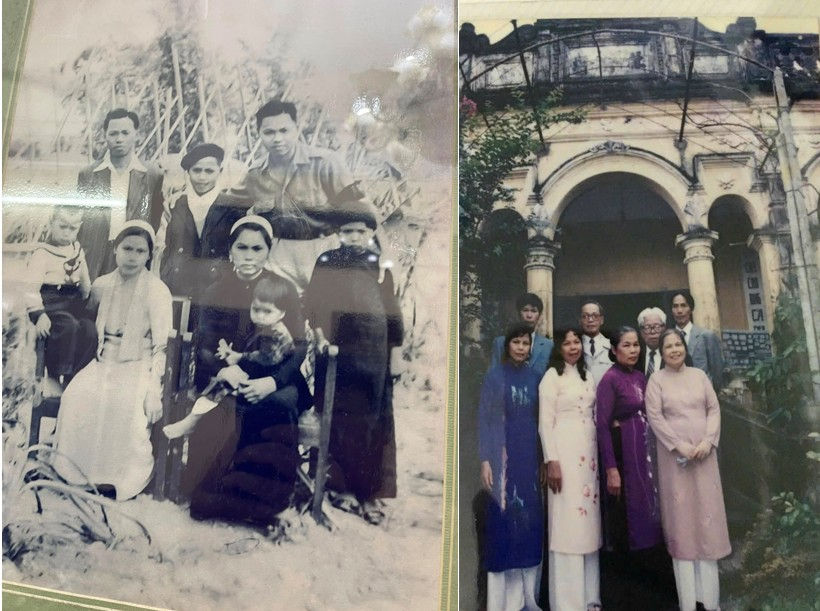
Look at the first photograph — 1947, somewhere in Bắc Giang province, northern Vietnam. The image is black and white, slightly worn at the edges, photographed through glass that catches the light, leaving a ghostly reflection across the faces of the people within. Yet they remain visible: two young women seated in front, each holding a small child. Behind them, standing in the back row from left to right, are the District Principal's sons and daughters — and there, among them, is his eldest son: Đỗ Như Kim, my father, young and upright, standing with his brothers and sisters before the lens of history.
What the photograph does not show is absence of another kind. My grandmother had already passed away in 1947 — the very year this picture was taken. The family was already navigating grief. And so it was the young woman seated in the middle, holding her child, who quietly stepped into that void. She was my aunt, the District Principal's daughter, and in the wake of her mother’s passing she took upon herself the immense burden of raising the remaining seven brothers and sisters — cooking, tending, guiding, holding the family together through the years of war and sacrifice that followed. She was more than an elder sister. She became, in every way that mattered, the mother the family no longer had.
Years later, this aun t would marry a man of extraordinary distinction: a Vice Premier of the Communist government of Vietnam. Her life of sacrifice and leadership in the home had prepared her, in ways perhaps no formal education could, for the world of statecraft and power that would surround her.
It was her sister standing next to her on the right in the photograph who would marry the war hero general — one of the victorious commanders at the Battle of Dien Bien Phu in May 1954, the nine-week siege that shattered French military power in Indochina and changed the course of Southeast Asian history. After the battle, as the smoke cleared and the hillside positions fell silent, he was one of the very few granted the solemn privilege of photographing the last standing tree on the main hill of the battle — a lone survivor in the devastated landscape, a silent witness to everything that had been lost and won. That photograph of a single tree standing on the hill of Dien Bien Phu is one of the most quietly powerful images of the entire war. And the man who took it came home to marry the woman standing to the right in that 1947 photograph — the District Principal's daughter who had stood beside her sister through everything
This is the family of the Bắc Giang school District Principal — a man of letters, of standing, of deep Nationalist conviction, who had shaped generations of young Vietnamese minds in the provincial schools of the North. He and his wife had raised their children in a household where learning and country were sacred. Three of his sons-in-law would become legendary figures in Vietnamese history. Phan Anh — who married the District Principal’s daughter seated to the left in the photograph, my aunt — was already one of the most celebrated lawyers in Vietnam and would go on to help write the modern constitution of an independent nation, bending his formidable legal mind to the project of giving a free Vietnam its foundational law. The son-in-law who married the District Principal’s daughter seated to the right — my aunt who stood beside her sister through the long years of loss and war — would rise to become a decorated general and hero of the Battle of Dien Bien Phu, the decisive victory that ended French colonial rule in Indochina in 1954. And the son-in-law who married the District Principal’s daughter in the middle — my aunt, the surrogate mother of the family — would rise to serve as a Vice Premier of the Communist government of Vietnam. These three men — a constitutional architect, a military commander, and a head of state — would become the pride of the family and symbols of a nation being born from fire and sacrifice
My father Đỗ Như Kim is there in the photograph — standing in the back row, from left to right, with his brothers and sisters. He is young and present, part of the family frame. But look closely at that young man and what you see is someone already poised at a crossroads. He had done the unthinkable. He had chosen love over duty, family over country, a woman over a war. After the French defeat at Dien Bien Phu in 1954, when Vietnam was divided at the 17th Parallel and the North went one way and the South another, he made his choice: he left Ha Nội heading south, building his life in Saigon rather than remaining in the North to join his father’s revolutionary cause alongside Ho Chi Minh. The District Principal, a lifelong Nationalist who had devoted everything to Vietnamese independence, never fully recovered from this wound. His heart had been broken not by the French, but by his own eldest son.
Yet even in his heartbreak, the District Principal had found words for his eldest son at the moment of farewell. Standing before him as my father prepared to leave Bắc Giang, my grandfather looked at him and said: “You are the bird that will fly the furthest — but one day, you will find your way home.” It was not an accusation. It was a prophecy. The District Principal was an educated man. He knew the nature of the child he had raised. He knew that this son — restless, feeling, drawn by love rather than ideology — would go farther than any of the
m. And he knew, with the quiet certainty of a father, that the distance would not be forever.
The prophecy proved costly for those left behind. After my father’s departure south, the new Communist government in Hanoi grew anxious. The District Principal was a man of influence and deep respect in Bắc Giang — a school principal, an educator, a figure whose loyalty the Party needed but could not fully trust, not with an eldest son who had gone to live among the Nationalists in the South. Afraid that the District Principal himself might follow, the government made a calculated move: one by one, they sent the remaining children — my father’s brothers and sisters — abroad to study in fellow Communist nations. The Soviet Union. Eastern Europe. China. It was framed as an honor, a privilege, a sign of revolutionary trust. But it was also, unmistakably, a set of golden chains — a way to ensure that the District Principal would never leave, because his children were now scattered across the socialist world, held there by the logic of the state. The bird that had flown furthest had, without knowing it, changed the course of every life he left behind.
The Man Who Kept Missing
History in Vietnam does not repeat — it rhymes, with heartbreaking precision.
When the French were defeated at Dien Bien Phu in May 1954, and the Geneva Accords divided Vietnam at the 17th Parallel, the North and South became two different countries — and two different worlds. My general uncle, who had fought bravely in that epic battle in the mountains of the Northwest, came to Ha Nội looking for his elder brother. He went to the places where my father had studied, to the streets where he had lived, to the people who might have known him. But my father was already gone. He had left after 1954, heading south, building a life, a practice, a family in Saigon. The uncle came looking for a brother and found only an empty address, an echo.
Twenty-one years passed. Vietnam endured a second war, longer and more devastating than the first. The South fell city by city. And in the final days of April 1975, when the tanks of the North rolled through the gates of the Presidential Palace and Saigon became Hồ Chí Minh City overnight, my uncle — the general, the hero of Dien Bien Phu — came south again. He came to Saigon to find the brother he had missed in Ha Nội twenty years before. He searched again. He knocked on doors, asked of old acquaintances, traced the addresses of a dentist who had once been chief of Saigon Central Hospital. But my father was already gone. He had escaped the day before the city fell, on a ship down the Mekong, out to international waters, eventually to Guam, then to America. The general uncle arrived at his brother's door and found it open to the Saigon wind, the rooms empty, the family photograph albums left behind.
Twice in a lifetime, the general had marched toward his brother. Twice, the brother had already crossed to the other side of history.
The Second Photograph — 1994
Now look at the second photograph. It is in color — or rather, in the faded palette of early 1990s Vietnamese photography, where the colors have the warmth of afternoon light filtered through memory. It is 1994. The setting is formal but joyful: a colonial-era building with ornate arches and columns, its façade aged and beautiful, somewhere in Ha Nội or perhaps a provincial city of the North. A group of eight people stands before it — four women in áo dài, their dresses in shades of deep blue, ivory, purple, and rose — and four men behind them, the eldest white-haired and wearing glasses, the others in suits and ties.
This is the reunion. It is 1994 that my father first returned — made possible when President Clinton normalized trade relations with Vietnam, allowing the country to join the international community and opening the door for the Vietnamese diaspora to come home. That same year, the gatherings had become a reality. My father, now an old man, stood again among the brothers and sisters he had left behind after 1954. The white-haired man at the center of the 1994 photograph is him — Đỗ Như Kim, born 1925, dentist, exile, father, the man who had chosen love over revolution. He is surrounded now by the family he once walked away from: his brothers, his sisters-in-law, his niecesare all smiling. The áo dài shimmer in the afternoon light, and the old French colonial building stands behind them like a witness to the entire century.
But the photograph in Ha Nội, as beautiful as it is, tells only half the story of that return. For my father did not come back only to stand before a colonial building with his siblings in their finest clothes. He went home — all the way home — Dục Tú, the village in Bắc Giang where his family had lived for generations. The village his grandfather had built. The village his father the District Principal had shaped through education and example. The village that the French had once threatened to burn to the ground — and where my father, as a young man, had stood before a French colonel and refused to let that happen, as told in Chapter 2.
When my father’s car turned down the road toward Dục Tú, the entire village came out to meet him. Word had traveled ahead — the eldest son of the District Principal, the man who had left for the South and then crossed the ocean to America, was coming home. Old men and women who had known him as a child lined the road. Younger villagers who had only heard stories of him stood beside their parents and grandparents. Children in their school clothes peered between the legs of adults. There were no cameras to capture it, but those who were there describe a scene of flowers, of noise, of tears, of the kind of unrestrained joy that only a forty-year absence can produce — the entire village in motion, pouring out of houses and fields, to receive the son who had flown the furthest and finally found his way back.
Among those who came forward that day was an old man — my father’s former driver. Decades had passed since they had last seen each other, yet the old man had never forgotten. It was this same driver who, all those years earlier, had gone to Ha Nội to find my father and bring him the urgent word: that the French colonel commanding the forces in the region had threatened to burn Đức Tú to the ground in revenge, and that only my father, with his standing as the District Principal's eldest son and his relationships on both sides of the conflict, had any hope of stopping it. The driver had tracked him down in the city, pressed the message upon him, and my father had returned to the village — returning not for his own sake but for the sake of every family, every house, every field his people had built across generations. He had faced the French colonel and the village had been spared, as Chapter 2 tells in full. Now, forty years later, the driver stood on that same road with tears on his face, taking the old man’s hands in both of his. He had been looking for him again — this time, to say: you came home.
What Love Cost the Family
To understand these two photographs, you must understand what it meant to be the eldest son of the Bắc Giang school District Principal in mid-20th century Vietnam. Primogeniture in Vietnamese tradition carried enormous weight — the eldest son was heir not just to property but to legacy, to moral duty, to the continuation of the family name and its values in the world. And in this family, the values were Nationalist, revolutionary, deeply committed to the liberation of Vietnam from colonial rule.
His brother-in-law — the general — embodied that path fully. He fought the French, survived Dien Bien Phu, and became a decorated hero of the new North Vietnamese state. Phan Anh — the most celebrated lawyer in Vietnam, who had married one of the District Principal's daughters, my aunt — chose the path of law and governance, bending his intellect to the project of building a sovereign Vietnamese legal identity. Both men were celebrated. Both men remained in the North. Both men honored the District Principal's legacy.
And my father? He honored love. That was the path he chose — a woman, a family, a dental practice, a life in the South. He was not political in the way his brothers-in-law were political. He was not a general, not a statesman, not a revolutionary. He was a man who had fallen in love and followed that love south, across the dividing lines of ideology and geography. The District Principal had wanted him to stand with Ho Chi Minh. Instead, he stood with my mother.
This is the great irony at the heart of this family's story: the man who was born to carry the most distinguished legacy — the eldest son of the educator, the one with the most to inherit — was the one who slipped away for the most personal of reasons. While one in-law wrote the constitution of a new nation, and another commanded armies in battle, my father repaired teeth and raised a family in Saigon, eventually fleeing not as a soldier but as a father, packing his dental instruments into a red bag as Saigon fell around him.
What the Photographs Tell Us Together
Place the two photographs side by side in your imagination. In the 1947 image, the children of the District Principal have gathered — brothers and sisters and their young families, captured in a moment between wars. Their grandfather, the District Principal himself, is not in the frame; this is a photograph of his legacy, not of the man himself. The daughters are beautiful and proud. Their husbands will become famous. But the eldest son, already gone to Ha Nội with a woman he loves, is missing from the frame.
In the 1994 photograph, the eldest son has returned. He is white-haired and old. He is surrounded by family. But forty-seven years stand between these two images — years of war, separation, exile, longing, and the kind of love that outlasts everything. The general who came twice to find him is there too, finally standing beside the brother who always slipped away. The constitution has been written. The battles have been fought. The country has been reunified. And the eldest son of the Bắc Giang District Principal has come home, at last, not as a revolutionary, not as a soldier, not as a statesman — but as a man who chose love, and who carried that love across oceans and decades until he could lay it down, gently, in the place where he began.
Coda: What the Vietnamese Creation Story Knew
Vietnam was born from a love that could not last — the dragon who returned to the mountains and the sea fairy who returned to the water, leaving their eldest son to rule the land between. Separation was built into the very DNA of this country. Reunion was always the dream deferred, the tide that pulled without ceasing.
My father's story was Vietnam's story: the dragon's son who went one direction while his brothers went another, separated by love and war and ocean, circled twice by a searching general, and finally reunited not by victory or defeat, but by the simple passage of time and the opening of borders.
When he passed, we brought him home. He sleeps now at the feet of his parents, in the village he once saved from the French who had wanted to burn it down. The man who left is home. The reunion, in the end, was complete.


Comments